How GLP-1 Medications Support Weight Loss
Reviewed using published clinical research and FDA-approved prescribing guidance.
Before choosing a provider, it helps to understand how GLP-1 medications actually work — and why doctors are calling them one of the biggest breakthroughs in medical weight loss.
What Are GLP-1 Medications?
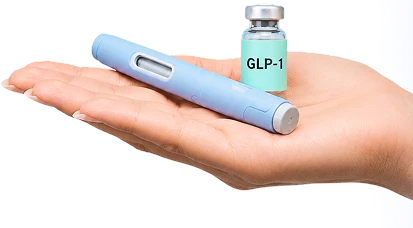
GLP-1 receptor agonists are prescription medications that mimic a naturally occurring hormone involved in appetite regulation and blood sugar control. Not all of these medications work in exactly the same way: tirzepatide is a dual GIP and GLP-1 receptor agonist, while semaglutide acts on the GLP-1 receptor alone. When prescribed under medical supervision, they are commonly used as part of structured weight-management programs.
GLP-1 medications are available in two distinct categories:
FDA-approved branded medications including Wegovy® (semaglutide), Ozempic® (semaglutide), Zepbound® (tirzepatide), and Mounjaro® (tirzepatide) have been reviewed and approved by the FDA for specific indications. Clinical efficacy and safety data referenced on this page applies to these FDA-approved formulations only.
Compounded Semaglutide and Compounded Tirzepatide are prepared by state-licensed compounding pharmacies and offered by many telehealth providers, typically at a lower monthly cost. Compounding is a long-established practice in US pharmacy, used when a provider determines a customized formulation or dose is appropriate for a specific patient. Compounded drugs are not FDA-approved, and the FDA does not review their safety, effectiveness, or quality. Clinical trial results for branded drugs do not carry over to compounded versions.
Access to compounded versions expanded during the 2024���2025 national shortages of these medications, and although those shortages are now resolved, compounded semaglutide and tirzepatide remain available through specific legal pathways: state-licensed (503A) pharmacies can still prepare a customized formulation for an individual patient under a prescription when there's a specific medical need the standard product doesn't meet.1 That's exactly why the pharmacy behind a compounded prescription matters, and why pharmacy sourcing is one of the factors we weigh when ranking providers.
How They Work
These medications support weight loss through several complementary mechanisms:
- •Reduced appetite signals, helping limit hunger between meals
- •Slower gastric emptying, meaning food stays in the stomach longer
- •Increased satiety, so patients feel full sooner and for longer
Together, these effects may lead to reduced calorie intake over time.
What Clinical Studies Show
In large, well-controlled clinical trials, GLP-1–based medications such as semaglutide and tirzepatide have been associated with clinically meaningful average weight loss when used alongside lifestyle changes like diet and physical activity.
Results were observed over approximately 68–72 weeks, with outcomes varying based on medication type, dose, treatment duration, and individual response.
Important Medical Considerations
While GLP-1 medications represent a significant advancement in medical weight management, they are not appropriate for everyone.
Eligibility, dosing, and long-term treatment decisions must be determined by a licensed healthcare provider based on an individual's medical history and health profile.
Like any prescription medication, GLP-1 and GLP-1/GIP treatments have safety considerations — which is one reason they're prescribed and monitored by a licensed provider rather than sold over the counter. Semaglutide and tirzepatide carry a boxed warning for a risk of thyroid C-cell tumors (based on animal studies2), and they aren't right for everyone, including those with a personal or family history of medullary thyroid carcinoma (MTC) or MEN2, or who are pregnant. Other warnings include pancreatitis and gallbladder problems, and a higher risk of low blood sugar when these medications are combined with insulin or a sulfonylurea. The most common side effects are gastrointestinal — nausea, vomiting, diarrhea, and constipation — and usually ease over time.
Best GLP-1 For Weight Loss
Tirzepatide (Zepbound®) has led to some of the biggest average weight loss in recent studies. In large clinical trials, adults with obesity who took it along with a reduced-calorie diet and more exercise lost about 15% to 21% of their body weight over 72 weeks, depending on the dose (5, 10, or 15 mg).4
Semaglutide (Wegovy®) is also very effective. In clinical trials, adults with overweight or obesity lost about 15% of their body weight over 68 weeks when they paired it with lifestyle changes.5
- •Tirzepatide (Zepbound®): Works in two ways in the body. In a head-to-head study of adults with obesity (without type 2 diabetes), people on tirzepatide lost more on average — about 20% of their body weight — than those on semaglutide, at about 14%, over 72 weeks.6 Tirzepatide is also sold as Mounjaro®, which is approved to treat type 2 diabetes.
- •Semaglutide (Wegovy®): Very effective and widely used for weight loss. It led to a bit less weight loss than tirzepatide in that head-to-head study, but it's still one of the top choices. Semaglutide is also sold as Ozempic®, which is approved for type 2 diabetes.
How to Choose the Best GLP-1 Program for You
Not all GLP-1 programs are the same. The right one can mean safer care, better results, and fewer surprises.
Here are the key factors to consider before getting started:
- •Medical Oversight — Licensed clinicians review your health and determine if treatment is right for you.
- •Clear Eligibility — Upfront criteria, simple onboarding, and no confusing steps.
- •Ongoing Support — Follow-ups, progress tracking, and access to medical guidance over time.
- •Convenience — Online consultations, easy communication, and home delivery (where available).
- •Transparent Pricing — Clear costs with no hidden fees or unexpected add-ons.
Getting GLP-1 Treatment Online: What to Expect
Most leading GLP-1 programs now operate through licensed telehealth providers, allowing patients to begin treatment without in-person visits.
The process typically includes:
- •Completing a secure online health intake
- •Reviewing eligibility with a licensed healthcare provider
- •Receiving medication via home delivery or local pharmacy pickup, if prescribed
This model allows patients to access medical weight-loss treatment with professional oversight, follow-up care, and ongoing support — all remotely.
Programs vary in clinician involvement, pricing, and medication availability, which is why choosing the right provider matters.